
 Business Applications
15 min
Business Applications
15 min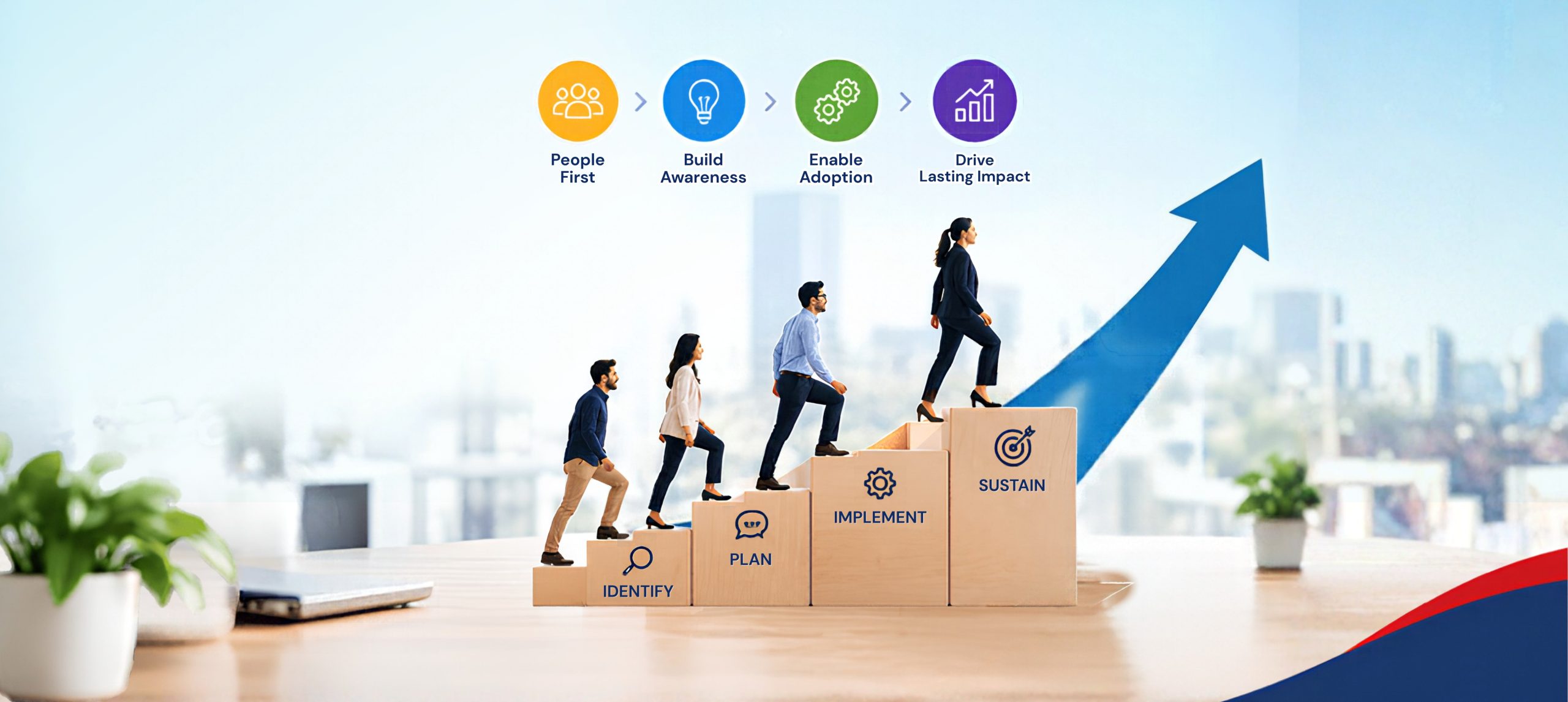
Organizations rarely struggle with change because they cannot buy new technology or design a new process. The harder challenge is getting people to actually work differently once the change arrives.
A company may invest in a new ERP platform, move workloads to the cloud, introduce AI, restructure departments, merge with another organization, or redesign customer processes. Yet the technology alone does not create the expected business value. Employees have to understand the reason for the change, know what is expected from them, develop the necessary skills, and have enough support to make the new approach part of their everyday work.
This is where organizational change management services become important. Change management provides a structured approach for helping people move from a current way of working toward a desired future state while keeping business objectives, employee experience, adoption, and long-term sustainability in focus. Prosci describes change management as an approach centered on preparing, equipping, and supporting individuals through change.
For businesses across the USA, this becomes increasingly relevant as digital transformation, AI adoption, cloud modernization, workforce changes, and process automation continue to reshape how organizations operate.
Change Is Not a Technology Problem Alone
Imagine a U.S. manufacturer implementing a modern ERP system. The software is configured correctly, data is migrated, integrations are working, and the system goes live on schedule.
But six months later, employees are still maintaining spreadsheets because they do not trust the new workflows. Managers continue requesting reports through old processes. Teams create workarounds instead of using the platform as designed.
Technically, the implementation happened.
Operationally, the change did not.
This distinction is at the heart of organizational change management. Microsoft also emphasizes that successful business-solution implementation requires planning for how an organization will adopt and use the solution, because a technically successful project can still fail to deliver expected outcomes when user adoption is weak.
The real question therefore becomes:
What needs to change in people’s daily work for the business transformation to succeed?
That question changes the entire approach.
What Is Organizational Change Management?
Organizational change management is a structured approach to helping employees, teams, leaders, and other stakeholders transition from existing processes and behaviors to new ways of working.
It can support changes involving:
- New technology or software
- Cloud migration
- ERP and CRM implementation
- AI adoption
- Business process redesign
- Mergers and acquisitions
- Organizational restructuring
- New operating models
- Compliance and security initiatives
- Workforce transformation
- New customer-service strategies
The goal is not simply to announce that something is changing. It is to help people understand the change, prepare for it, adopt it, and continue using the new approach effectively.
That makes change management both a people discipline and a business capability. Prosci distinguishes change management at the project level from organizational change capability, where organizations develop the ability to respond to and manage change more consistently.
The Real Cost of Ignoring the People Side of Change
Businesses often budget heavily for software, infrastructure, implementation, consulting, and project management while treating employee adoption as something that will happen naturally.
It usually does not.
When employees do not understand why a transformation is happening, they may delay adoption. When training arrives too late, employees may feel unprepared. When managers cannot answer practical questions, uncertainty spreads. And when leadership stops communicating after launch, employees can easily return to familiar processes.
The result can include lower adoption, duplicated work, productivity disruption, inconsistent processes, frustrated employees, and a slower return on technology investments.
The issue is particularly important during large-scale transformations where one project can affect hundreds or thousands of employees across different departments, locations, and roles.
Organizational Change Should Start Before Go-Live
One common mistake is treating change management as a training exercise that begins shortly before implementation.
Training matters, but it is only one part of the journey.
Effective organizational change management should begin while the organization is still defining what the change will look like. Teams should identify who will be affected, how their work will change, what concerns may emerge, which leaders need to sponsor the initiative, and what employees will need at different stages.
A useful change strategy considers three connected questions:
What is changing?
This defines the technology, process, structure, role, or behavior that will be different.
Who is affected?
Different groups may experience the same transformation in completely different ways.
What does successful adoption look like?
The organization needs measurable indicators showing whether the new approach is actually being used.
This moves change management away from generic communication and toward measurable business adoption.
Employees Do Not Experience Change in the Same Way
A CFO, sales representative, warehouse employee, IT administrator, and customer-service manager may all be affected by the same transformation, but their concerns will not be identical.
A finance team may care about reporting accuracy and new approval workflows. Sales teams may care about CRM usability. Operations may worry about production disruption. Managers may want visibility into performance. IT teams may be focused on security and integration.
This is why one generic email campaign rarely creates meaningful adoption.
Organizations should develop role-specific communication, training, support, and feedback mechanisms based on how each group interacts with the change.
The more directly a change affects someone’s daily responsibilities, the more practical the support needs to be.
Leadership Is More Than Sending the Announcement
Executives often introduce major transformations with a company-wide announcement. That creates awareness, but leadership involvement should not end there.
Employees watch what leaders do not only what leaders say.
If executives promote a new digital process but continue requesting information through old channels, employees receive conflicting signals. If managers encourage AI adoption but never provide time for experimentation and training, adoption may remain limited.
Strong sponsorship means leaders consistently communicate the reason for change, reinforce priorities, remove obstacles, listen to feedback, and demonstrate the behaviors expected from the organization.
Change management therefore needs leadership participation throughout the transformation rather than only at launch.
Training Should Teach the New Way of Working
Traditional training often focuses on showing employees where buttons are located in a new application.
That may not be enough.
Employees need to understand how the technology changes their work. Instead of simply teaching someone how to create a record in a CRM, for example, training should connect the action to the new sales process and explain what information is expected, why it matters, and how other teams depend on that information.
Effective training should be connected to real job responsibilities.
For complex transformations, organizations can combine instructor-led sessions, role-based learning, demonstrations, hands-on practice, documentation, peer support, and post-launch assistance.
The goal is confidence not simply course completion.
Communication Should Answer “Why?”
Change communications often focus heavily on what is happening:
“We are launching a new platform.”
“We are changing this process.”
“We are moving to a new system.”
Employees also need to understand why.
What problem is the organization trying to solve?
How will the change affect employees?
What happens if the organization does nothing?
What will success look like?
What support will employees receive?
Clear answers reduce uncertainty and give employees context for the transformation.
Prosci’s ADKAR framework similarly places awareness of the reason for change at the beginning of the individual adoption journey, followed by desire, knowledge, ability, and reinforcement.
Measure Adoption, Not Just Project Completion
A project can be completed on time and still fail to produce the intended business outcome.
That is why organizations should measure what happens after implementation.
Depending on the transformation, useful indicators can include:
- Adoption and usage rates
- Process compliance
- Training effectiveness
- Employee feedback
- Support-ticket trends
- Productivity changes
- Process cycle times
- User proficiency
- Customer experience indicators
- Business performance outcomes
For example, if a company introduces a new CRM, measuring whether the system went live is less meaningful than understanding whether sales teams consistently use it, whether data quality has improved, and whether the new process supports better customer visibility.
Change management becomes much stronger when adoption is treated as a measurable business outcome rather than an assumption.
Resistance Is Information
Resistance is often described as something organizations need to eliminate.
A more useful approach is to understand what resistance is communicating.
Employees may resist because they do not understand the reason for change. They may worry about losing responsibilities, lack confidence in their skills, distrust the new technology, or have experienced poorly managed transformations in the past.
Sometimes resistance also identifies genuine problems in the proposed change.
Listening to employees can reveal workflow issues, training gaps, unrealistic timelines, or communication problems before they become larger obstacles.
Instead of asking, “How do we stop resistance?” organizations can ask:
“What is this resistance telling us?”
That shift can turn employee feedback into an important source of transformation insight.
Organizational Change Management in Digital Transformation
Digital transformation provides one of the clearest examples of why change management matters.
Consider a U.S. organization moving from legacy applications to Microsoft cloud technologies. The technical program may involve migration, integration, identity, cybersecurity, data, applications, and infrastructure.
But employees may experience the project very differently.
Their tools change. Their workflows change. Their collaboration methods change. Their responsibilities may change.
The technical roadmap explains how the systems move.
The change roadmap explains how people move with them.
This is why organizational change management services can complement technology implementation, cloud transformation, ERP modernization, Microsoft 365 adoption, AI initiatives, and other large-scale technology programs.
A Practical Change Management Roadmap
A successful change strategy does not have to be unnecessarily complicated. It needs to connect business goals with employee adoption.
A practical roadmap can include:
- Define the business outcome
Start by identifying what the organization wants to achieve not simply what technology it wants to deploy.
- Assess the impact
Identify which departments, roles, processes, behaviors, and locations will be affected.
- Identify stakeholders
Understand who sponsors the change, who manages affected teams, who influences adoption, and who needs additional support.
- Build the communication strategy
Develop clear messages for different audiences and stages of the transformation.
- Prepare employees
Provide role-based training, resources, demonstrations, and opportunities to ask questions.
- Support implementation
Provide assistance during rollout and respond quickly to adoption barriers.
- Measure adoption
Track whether people are actually using the new processes, systems, and behaviors.
- Reinforce the change
Continue coaching, communication, measurement, and leadership reinforcement after implementation.
Prosci’s broader methodology similarly separates organizational change into preparing the approach, managing the change, and sustaining outcomes.
Where Organizational Change Management Services Can Create Value
Organizations may benefit from professional change management support when internal teams are already overloaded, when a transformation affects multiple departments, or when adoption is critical to the project’s business case.
External expertise can help create a structured change strategy, assess organizational impact, develop communication and training programs, support leadership alignment, measure adoption, and establish processes for sustaining the transformation.
This can be particularly useful for organizations undertaking complex initiatives such as ERP implementation, Microsoft 365 modernization, cloud migration, AI adoption, cybersecurity transformation, or enterprise process redesign.
The objective is not to replace internal leadership. Instead, change specialists can work alongside business and technology teams to create a more coordinated path from implementation to adoption.
Cambay Solutions and Organizational Change
Technology transformation and organizational change are closely connected. Cambay Solutions can support organizations looking beyond the technical implementation to consider how new Microsoft technologies, business applications, cloud platforms, and digital processes will be adopted within the organization.
For U.S. businesses, this people-centered approach can be particularly valuable when transformation affects multiple teams, locations, workflows, or business functions.
Cambay Solutions can help organizations connect technology initiatives with business objectives, user needs, process changes, training requirements, adoption planning, and ongoing improvement. The emphasis is on creating a transformation approach where technology becomes part of everyday business operations rather than remaining a standalone IT project.
Whether an organization is modernizing Microsoft environments, implementing business applications, adopting AI, improving cloud capabilities, or redesigning operational processes, the human side of transformation should be considered from the beginning.
When Should a U.S. Business Consider Change Management?
There is no single project size that determines whether change management is necessary.
However, organizations should consider it when a transformation significantly changes how employees work.
Signs may include:
- Employees are using workarounds instead of new systems.
- Multiple departments are affected by one transformation.
- A new platform requires significant behavior changes.
- Previous technology projects experienced adoption problems.
- Leadership wants measurable adoption and business outcomes.
- Employees are uncertain about how a change affects their roles.
- The organization is managing several transformations simultaneously.
The earlier change management enters the project, the more opportunities the organization has to identify adoption barriers before they become expensive problems.
FAQs About Organizational Change Management
What is organizational change management?
Organizational change management is a structured approach for preparing, supporting, and enabling people to adopt new processes, technologies, behaviors, or organizational structures. It focuses on the people side of transformation while connecting adoption to business outcomes.
Why is organizational change management important?
It helps organizations address the human factors that influence whether a transformation is actually adopted. Without adoption, a technically successful project may not deliver its intended business value. Microsoft specifically recommends planning for adoption and change when implementing business solutions.
What are organizational change management services?
Organizational change management services can include change-impact assessments, stakeholder analysis, leadership alignment, communication planning, training, employee engagement, adoption measurement, transition support, and reinforcement activities.
Is change management only for technology projects?
No. It can support technology implementations as well as mergers, acquisitions, restructuring, process redesign, cultural changes, operating-model changes, and other organizational transformations.
How does change management reduce resistance?
Rather than simply trying to eliminate resistance, effective change management identifies why employees may be hesitant and addresses the underlying concerns through communication, leadership involvement, training, support, and feedback.
When should change management begin?
Ideally, change management should begin during the planning stage of a transformation. Early involvement allows organizations to understand impacts, prepare stakeholders, design communication, and address adoption risks before implementation.
How do you measure change management success?
Success can be measured through adoption, usage, proficiency, employee feedback, process performance, training effectiveness, and business outcomes. The appropriate metrics depend on the type of transformation.
What role does leadership play in change management?
Leaders provide sponsorship, communicate the purpose of the transformation, demonstrate expected behaviors, remove obstacles, support managers, and reinforce the new way of working.
Conclusion
Organizational change is not completed when a new system goes live, a new policy is announced, or a transformation project reaches its final milestone.
It is completed when people can successfully operate in the new environment and when the organization can sustain the resulting changes.
That requires more than communication. It requires leadership, employee involvement, role-specific preparation, practical training, ongoing support, adoption measurement, and reinforcement.
For U.S. organizations navigating cloud modernization, AI adoption, ERP transformation, Microsoft technology initiatives, restructuring, or process improvement, organizational change management services can provide the structure needed to connect business transformation with the people responsible for making it work.
The strongest transformation strategy is therefore not simply:
“What technology are we implementing?”
It is:
“What will change for our people, and what will help them succeed?”