


 Dynamics 365 Business Central
15 min
Dynamics 365 Business Central
15 min
Introduction
Data is everywhere, but insight is still hard to find.
In the modern business landscape, we are generating more data than ever before. CRM systems track every customer interaction, ERP systems manage financials and supply chains, eCommerce platforms log every click, and operational databases monitor real-time performance. Yet, for many organizations, this abundance of information has led to a state of paralysis rather than progress. We call this phenomenon: Data Chaos.
Leaders are often forced to make high-stakes decisions based on outdated Excel sheets, while their teams spend countless hours reconciling numbers that come from different departments. According to a study by Forrester, data that isn’t fully utilized costs companies between 15-20% of their revenue growth. The problem isn’t a lack of data; it’s a lack of clarity.
On March 10, 2026, at 2:00 PM CST, Cambay Solutions is hosting a pivotal webinar, “From Data Chaos to Clarity,” led by Scott Stamper, our Executive Director of Strategic Business Analytics. We will explore how the combination of Microsoft Fabric and Power BI is revolutionizing the way companies handle data.

In this article, we will preview the core concepts of that webinar, diving deep into why traditional reporting breaks down, how Microsoft Fabric unifies your data estate, and how the Cambay Analytic Data Layer (ADL) serves as the bridge between raw data and executive-ready insights.
The Breaking Point: Why Traditional BI Fails at Scale
To understand the solution, we must first understand the pain. Most organizations do not start with bad data intentions. They usually begin with a simple Excel spreadsheet. Then, the company grows. The spreadsheet becomes an Access database. The Access database becomes a departmental SQL server. Soon, the marketing team buys a SaaS tool, sales uses Salesforce, and finance runs on NetSuite.
Before long, you have what we call the “Island Effect.”
- Siloed Systems: Data is trapped in departmental applications. The marketing team has one view of the customer, while support has another. These views rarely align.
- The Tyranny of Excel: Excel is a fantastic tool, but it was not designed to be a enterprise-wide reporting solution. When different departments build their own reports in Excel, you end up with multiple versions of the “truth.” The CFO sees one revenue number, while the CRO sees another.
- Slow Reporting Cycles: By the time the IT team extracts, transforms, and loads (ETL) data from various sources into a data warehouse, and then builds a report, the data is often weeks old. In a fast-paced business environment, reacting to news that is two weeks old is like driving a car by looking only in the rearview mirror.
- Lack of Governance: When power users start creating their own Access databases or Excel macros, they create “shadow IT” systems. These systems lack the security and governance required to protect sensitive company data, leading to compliance risks.
At Cambay Solutions, we see this scenario play out across industries, from manufacturing to high-tech sales. As Scott Stamper notes, “The goal isn’t just to collect data; it’s to create a trusted foundation where business users can explore data safely without needing a PhD in data engineering.”
Microsoft Fabric: The Great Unifier
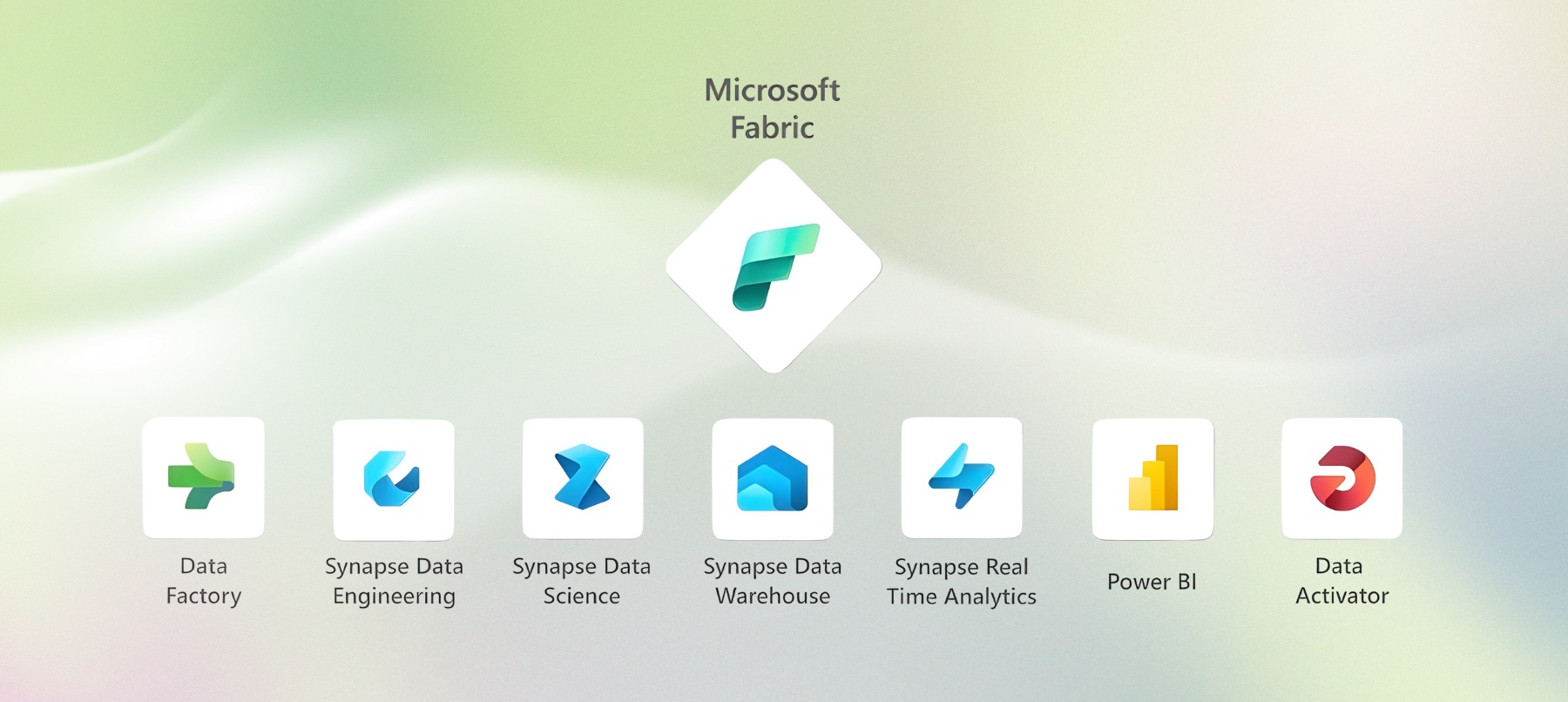
This is where Microsoft Fabric enters the scene. Announced as the “Data Platform for the AI Era,” Fabric is not just another tool; it is a complete overhaul of how data is managed.
Think of Fabric as the “OneDrive for your data.” It is built on a foundation called OneLake – a single, unified, cloud-scale data lake that serves every function of your business. Instead of copying data from your CRM to your data warehouse, and then to your analytics tool, Fabric allows all these systems to speak natively to one another.
Key Benefits of Microsoft Fabric:
- Unified Experience: Fabric combines data engineering, data integration, data warehousing, and business intelligence into a single, SaaSified platform. You no longer need to stitch together disparate Azure components.
- Shortcuts and Mirroring: One of Fabric’s most powerful features is the ability to create “shortcuts” to data residing in other clouds (like AWS S3) or on-premise systems. This means you can analyze data in real-time without massive, expensive data duplication .
- Built-in Governance: With Fabric, IT can set security and access policies at the lake level. This ensures that when a business user accesses data in Power BI, they are looking at a governed, certified dataset—not a rogue spreadsheet saved on a local hard drive.
For manufacturers and multi-national corporations, this is a game-changer. Plant managers can access real-time production data from the MES system, while the CFO looks at financial data from the ERP, all within the same semantic model. Cambay Solutions has seen firsthand how implementing Fabric can cut analytics project timelines by nearly 50% .
The Power BI Advantage: From Unified Data to Actionable Insights
Once your data is resting comfortably in Microsoft Fabric’s OneLake, the next step is visualization and analysis. This is where Power BI shines.
Because Power BI now runs natively within the Microsoft Fabric ecosystem, it shares the same data models and security protocols. This deep integration ensures that the data used for machine learning models is the same data used for executive dashboards.
Turning Insights into Action:
- Executive-Ready Dashboards: Power BI allows you to move beyond static reports. With the data unified in Fabric, you can create interactive dashboards that show the relationship between sales activities and financial outcomes in real time.
- Governed Self-Service: One of the biggest fears of IT departments is “self-service” leading to chaos. However, with Fabric, IT can certify specific datasets. Business users can then use Power BI to build their own reports on top of these certified datasets, ensuring they have the freedom to explore without the risk of accessing incorrect information.
- AI-Powered Insights: With Copilot in Power BI, users can ask questions in plain English (e.g., “Show me why sales dropped in the West region last month”) and get instant visualizations and root-cause analysis.
In a recent case study, Cambay Solutions helped a client in the water technology sector move from outdated sales reports to a real-time Power BI dashboard. By integrating 20 strategic KPIs directly from their operational systems, we empowered their sales team to react instantly to market changes, driving a significant uplift in revenue .
The Cambay Analytic Data Layer (ADL): The Secret Sauce
While Microsoft Fabric provides the engine and Power BI provides the cockpit, you still need a roadmap. That roadmap is the Cambay Analytic Data Layer (ADL) .
At Cambay Solutions, we don’t believe in one-size-fits-all solutions. The Cambay ADL is our proprietary methodology and framework for ingesting, modeling, and serving data. It acts as the bridge between your messy source systems and the pristine world of Microsoft Fabric.
What the Cambay ADL Does:
- Accelerates Time-to-Value: Instead of spending six months building a data warehouse from scratch, the ADL provides pre-built templates and best practices that fast-track your implementation.
- Harmonizes Disparate Data: The ADL is designed to handle the specific nuances of connecting CRM, finance, operations, and eCommerce data. It standardizes definitions so that “Customer ID” means the same thing in Salesforce as it does in NetSuite.
- Optimizes for Performance: We ensure that the data models built on top of Fabric are optimized for Power BI consumption. This means your dashboards load fast, even when querying billions of rows.
During the March 10th webinar, Scott Stamper will walk through a live Power BI report built on the Cambay ADL. Attendees will see concrete examples of how disparate data sources come together to tell a cohesive story.
Who Should Take Action?
This webinar and the strategies within are designed for a wide audience:
- Business and IT Leaders: If you are tired of hearing “we need more data” and want to start hearing “we have the insights,” this is for you.
- Sales and Operations Leaders: If you need to connect operational efficiency to revenue outcomes, you cannot miss this.
- Power BI Practitioners: If you are currently building reports and want to learn how to scale your impact using certified datasets and better governance, join us.
Conclusion
We are standing at the precipice of a new era in analytics. The era of data chaos is ending, and the era of clarity is beginning. With the power of Microsoft Fabric to unify data, Power BI to visualize it, and the Cambay Analytic Data Layer to structure it, organizations of all sizes can finally turn their data into their most valuable asset.
We invite you to join Scott Stamper and the Cambay Solutions team on March 10, 2026, at 2:00 PM CST. Don’t let your data remain a chaotic collection of numbers. Let us show you how to bring it into focus.
Save your spot today! Register ➡️ https://lnkd.in/g-tUq8bQ