Microsoft has moved on from Dynamics GP, NAV, SL and on-premises AX — support windows are closing, and every year you wait is a year further from patches, security updates and new capability. Cambay moves you to Dynamics 365 Business Central or Finance & Supply Chain Management with a proven, low-risk methodology built specifically for legacy Dynamics customers.
This isn't a "nice to have" cloud upgrade — it's a support-lifecycle problem. Dynamics GP, NAV, SL and on-premises AX are all past or approaching the end of Microsoft's support lifecycle, which means shrinking security patching, no new features, and — eventually — no support at all. Migrating now, on your own schedule, is a fundamentally lower-risk position than migrating later under pressure.
*Exact support end dates vary by product version and are set by Microsoft's official product lifecycle policy — Cambay confirms your specific version's current status as part of the migration assessment.
Your source system determines the target platform and the shape of the migration. Here's how each legacy Dynamics product maps forward.
The most common legacy migration Cambay handles. Chart of accounts, vendors, customers, inventory and historical GL transactions move into Business Central with a mapped, tested conversion process.
Business Central is the direct cloud successor to NAV, sharing the same underlying data model — which typically makes this the most straightforward of the four migration paths.
Project accounting, grant management and government-contracting customers on Dynamics SL move to Business Central with equivalent project costing and reporting capability, modernized for the cloud.
AX2012 customers typically need the enterprise scale of Dynamics 365 Finance & Supply Chain Management rather than Business Central. For the full AX2012-to-F&SCM methodology, see our dedicated migration content on the F&SCM page.
See the AX2012 Migration PathThe same phased, fit-gap-driven methodology Cambay uses across every Dynamics 365 migration — proven on Business Central and F&SCM engagements alike, applied here to legacy Dynamics source systems.
We map your current GP, NAV, SL or AX2012 configuration — customizations, workflows and reports — against Business Central or F&SCM to identify what transfers directly and what needs to be rebuilt.
Standardized data migration templates map your chart of accounts, master data and transaction history into the target system, with a cleansing pass to catch legacy data-quality issues before they move over.
Rather than a single high-risk cutover weekend, we run phased migrations with a parallel validation period — your team confirms the new system matches the old before the legacy platform is retired.
Reconciliation of opening balances and historical reports against your legacy system, plus hands-on support through your first full close in the new platform.
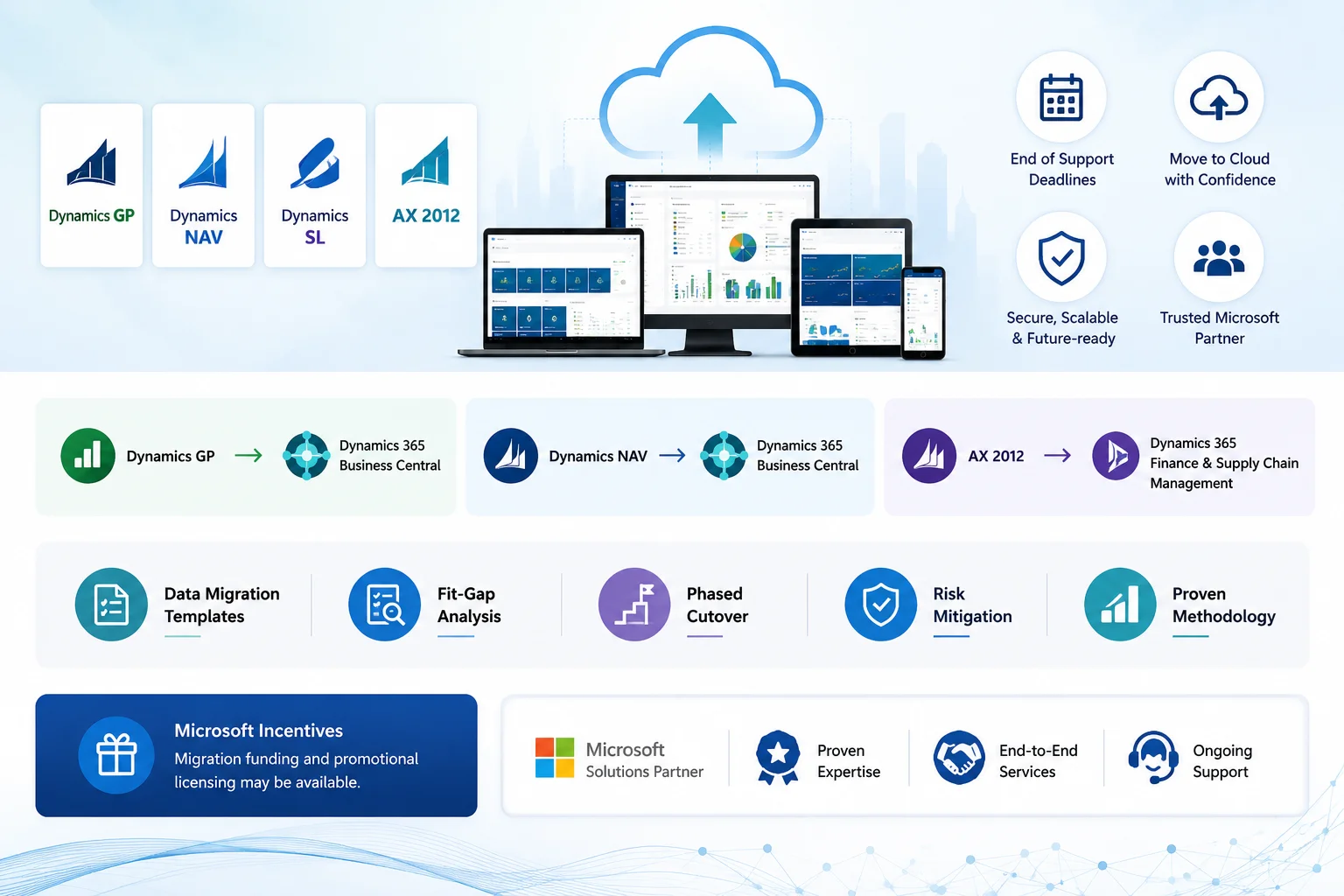
Microsoft periodically offers funding and promotional licensing to help legacy Dynamics customers move to the cloud. Programs and terms change — Cambay checks current eligibility as part of your migration assessment.
Microsoft has historically funded a portion of qualifying partner-led migration engagements for legacy Dynamics customers moving to Dynamics 365. Eligibility and funding amounts are confirmed at the time of your assessment.
Existing legacy Dynamics customers with active support agreements are frequently eligible for discounted or bridge licensing when moving to Business Central or F&SCM, reducing the cost of running both systems during transition.
These programs are typically tied to Microsoft's fiscal quarters and end-of-support timelines — the earlier you start your assessment, the more likely current incentives are still available.
Security patches, compliance updates and new capability again — instead of running on a version Microsoft no longer actively supports.
Years of transaction history and reporting data carried forward — nothing lost in the move, and no need to keep the old system running just to pull an old report.
Parallel validation before legacy retirement means no single point of failure and no "hope it works" go-live weekend.
A scoped migration assessment and fixed-scope project plan, so you know what the move costs before committing to it.
Everything GP, NAV, SL and AX2012 customers ask before moving to Dynamics 365 cloud with Cambay.
Ask an ExpertCambay's phased, parallel-run methodology is designed to minimize downtime rather than require a single disruptive cutover. Most clients run both systems briefly in parallel for validation, then switch over during a planned low-activity window — typically a weekend or month-end — rather than shutting down operations for an extended period.
Yes. Transaction history, master data and reporting data are migrated as part of the standard process — the amount of history you bring forward is a decision you make during the fit-gap analysis, not something you lose by default. Some clients choose to migrate several years of detail; others migrate current-year data and archive older history separately.
Timeline depends on data volume, customization complexity and which target platform you're moving to — Business Central migrations are typically faster than moves to Finance & Supply Chain Management. Cambay provides a firm timeline as part of the fixed-scope migration assessment, before any migration work begins.
The fit-gap analysis identifies every customization, custom report and integration in your current system and maps each one to an equivalent in Business Central or F&SCM — some transfer with configuration only, others need to be rebuilt using the target platform's tools. You get a clear list of which is which before migration work starts, not a surprise afterward.
It depends on your current support agreement, licensing status and Microsoft's current program terms, which change over time. Cambay checks your specific eligibility as part of the migration assessment and will tell you plainly if a program doesn't apply to your situation.
The full picture of Cambay's Integration & Migration services — including CRM and ERP migrations from Salesforce, HubSpot, SAP, Oracle and Sage.
ExploreWhere most GP, NAV and SL customers land — see the full cloud ERP platform beyond the migration itself.
ExploreThe enterprise-scale landing spot for AX2012 customers — full financials, supply chain and manufacturing at global scale.
ExploreStart the conversation today and unlock measurable growth with Microsoft technology.